Yes…with conditions. The FMCSA explicitly permits electronic DVIRs under 49 CFR 390.31, which governs the use of electronic documents and signatures in place of paper records. For an eDVIR to be compliant with Department of Transportation (DOT) requirements, it must:
Electronic signatures under FMCSA rules don’t require a wet signature or a specific technology; they require that the identity of the person signing can be confirmed and that the record cannot be altered after signing without detection. Most compliant eDVIR platforms use PIN-based or biometric authentication and timestamp locking to satisfy this.
Table des matières
The ELD mandate didn’t require eDVIR adoption, but it accelerated it. Many ELD-certified devices include eDVIR functionality built in, and for carriers that already deployed ELDs, adding eDVIR often required no additional hardware. The workflow integration made sense: If drivers are already completing their hours-of-service (HOS) records on a device, completing their DVIR on the same device is a natural extension.
| Feature | Paper DVIR | Electronic DVIR (eDVIR) |
|---|---|---|
| Completion method | Handwritten on printed form | Mobile app or in-cab device |
| Time to complete | 5–15 min (form-filling) | 3–8 min (guided checklist) |
| Legibility | Variable (often poor) | Always readable |
| Missing fields | Common (not caught until review) | Blocked by app validation |
| Defect notification | Manual handoff to dispatcher/mechanic | Instant automatic alert |
| Photo documentation | Rare (adds time and hassle) | Built-in & attached to defect record |
| Signature capture | Physical signature on paper | Electronic signature with timestamp |
| Audit retrieval | Manual search through binders | Search by date, driver, or vehicle |
| Retention compliance | Risk of loss, damage, or misfiling | Automatic cloud storage |
| Open defect tracking | Manual follow-up required | System tracks until closed |
| Integration with maintenance | None without manual data entry | Direct work order generation |
| Driver accountability | Timestamp unreliable | GPS + timestamp + device ID logged |
| Cost per form | Paper + printing + filing labor | Monthly platform fee, no per-report cost |
| Integration with maintenance | None without manual data entry | Direct work order generation |
The gap in outcomes isn’t subtle. For fleets that switch from paper reports, the most immediate win is defect visibility. Dispatchers and maintenance coordinators know about a brake issue the moment a driver logs it, rather than when the clipboard makes it back to the office.

“Going digital” sounds like an IT initiative. The actual benefits are operational and financial.
For a fleet with 50 drivers completing two DVIRs per day, that’s 100 inspection events daily. If paper processing (i.e., completing, reviewing, filing, and retrieving) adds just 3 minutes per report compared to digital, that’s 5 hours of labor per day, or roughly 1,800 hours per year. That’s before factoring in the time spent hunting for records during audits.
eDVIR cuts administrative overhead at every stage: Driver completion, dispatch review, maintenance follow-up, and audit response.
Paper DVIRs are only as good as the driver’s memory and motivation in the moment. Electronic DVIRs enforce completeness; the app won’t let a driver submit until all required fields are filled. This eliminates the single most common DVIR violation: incomplete forms.
Guided checklists also help drivers who might miss components on a paper form. When the app walks you through brakes, steering, lights, tires, and coupling devices in sequence, you don’t skip anything.
During a DOT compliance review or roadside inspection, an officer may request DVIRs going back 3 months. With paper, that’s a search through filing cabinets or boxes — assuming nothing was lost, misfiled, or damaged. With eDVIR, you simply search by date and vehicle number, and the system returns results in seconds.
The structured, consistent format of electronic reports also makes it easier to demonstrate patterns of compliance. Every report looks the same. Every signature is verifiable. Every timestamp is tied to a device and location.
This is one of the most underrated features of eDVIR systems. When a driver finds a cracked mirror, a worn tire, or a damaged coupling, they can photograph it on the spot and attach the image directly to the defect record. That photo becomes part of the legal record.
This protects both the driver and the carrier. If there’s a dispute about when damage occurred, the timestamped photo is evidence. If a mechanic certifies a repair, the before/after documentation is in the system. For fleets dealing with owner-operators or shared vehicles, this is particularly valuable.
The most dangerous gap in any DVIR process is the open defect — i.e., a problem that was reported but never certified as repaired. Under FMCSA rules, a vehicle with a reported unresolved defect cannot be returned to service until a mechanic either fixes it or certifies it as not affecting safe operation.
On paper, tracking open defects is a manual process. In an eDVIR system, every defect stays flagged until the mechanic certification is entered. You can run a report at any time showing all open defects across your fleet. This is compliance management, not just documentation.
A DVIR is not an island. The inspection report is most valuable when it feeds directly into the systems that can act on the information.
For carriers using ELDs for HOS compliance, eDVIR integration within the same platform creates a seamless end-of-day workflow. The driver completes their DVIR in the same app they use for HOS logging. Records are associated with the same vehicle and driver profile, making cross-referencing straightforward for both internal review and external audits.
Some ELD platforms also cross-reference DVIR data with trip records. If a vehicle shows movement after a defect was logged but before a repair was certified, then that’s an automatic compliance flag.
Integration between eDVIR and plateformes de gestion de flotte adds context to inspection records. Defects can be associated with vehicle location via GPS and odometer reading automatically. Maintenance intervals can be tracked against actual mileage rather than estimates. A brake defect reported at mile 187,000 is logged against the vehicle’s actual maintenance history, not a manually-entered number.
For fleet managers, this integration means a single view of vehicle health across the entire operation. You can see which vehicles have open defects, which are due for scheduled maintenance, and which drivers have the lowest DVIR completion rates — all in one place.
When a driver reports a defect, the fastest path to resolution is an automatic work order. The best eDVIR systems integrate directly with maintenance management software so that a flagged defect immediately triggers a work order in the shop queue, with the driver’s description, attached photos, vehicle ID, and location all pre-populated.
This eliminates the phone call or paper handoff between driver, dispatch, and maintenance. The defect report is the work order initiation. Mechanics close the loop in the same system, and the DVIR is automatically certified once the repair is complete.
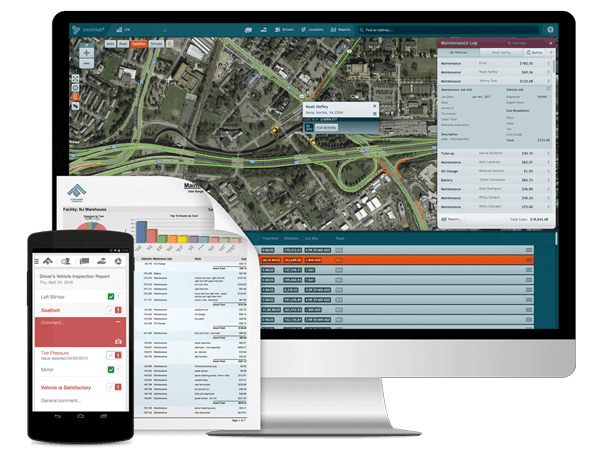
Over time, eDVIR data reveals patterns. Which vehicles have recurring defect types? Which routes correlate with higher mechanical wear? Which drivers consistently report defects that others miss on the same equipment?
This data informs preventive maintenance schedules, driver training, and vehicle procurement decisions. The result is actionable operational intelligence drawn from routine compliance documentation.
Switching from paper to electronic DVIRs is straightforward for most fleets, but the transition goes smoother with a clear process.
Not all “electronic DVIR” solutions are created equal. Before selecting a platform, verify:
Ask vendors specifically about how their platform handles the repair certification workflow. The closed-loop defect resolution piece is where many low-cost apps fall short.
Before rollout, map out which systems your eDVIR platform needs to talk to: Your ELD, your fleet management software, your maintenance system. Most enterprise platforms offer API integrations or pre-built connectors. The more integrated your stack, the more value you’ll extract from the data.
Driver adoption is the make-or-break factor in any eDVIR rollout. Drivers who understand that the DVIR matters because their personal liability is on the line if a defect goes unreported and causes an accident tend to take it more seriously than drivers who see it as another checkbox.
Keep training focused on the app workflow, not the compliance theory. Show drivers how to flag a defect with a photo. Show them what happens when they submit, including who gets notified and how fast the repair gets scheduled. When drivers see the system actually respond to their reports, they trust it more.
Before going live, capture your current DVIR completion rate, average number of open defects at any time, and average time to close a defect. These numbers give you a before/after comparison once the system is running, and they’re useful for justifying the platform cost to leadership.
Some fleets do a hard cutover; others run paper and electronic in parallel for 30-60 days. The parallel period lets drivers get comfortable with the new workflow without pressure, and it gives you a chance to catch any gaps in the electronic process before paper is the only backup.
Once you’re confident the digital workflow is complete, retire the paper forms. Keep your last paper records until they age out of the 3-month retention window, then you’re fully digital.
Within the first 90 days, run an internal audit of your eDVIR records. Check completion rates by driver. Review open defect aging. Look for any vehicles with patterns of repeated defects. This review both validates your compliance and surfaces operational issues you might have missed on paper.
Fleet managers evaluating eDVIR platforms should prioritize these capabilities:
Compliance completeness: Does the platform cover every required inspection element for your vehicle types? Does it handle both tractor and trailer inspections separately?
Offline functionality: Drivers operate in areas without reliable connectivity. The app must be able to complete and locally store a DVIR offline, then sync when a connection is available.
Defect photo capture: Photo attachment to defect records should be standard, not an add-on.
Repair workflow integration: How does a logged defect become a work order? Is it automatic? Manual? What does the mechanic certification flow look like?
Audit export: Can you produce a complete, FMCSA-compliant report of all DVIRs for a vehicle, driver, or date range quickly? Can it be exported to PDF for a roadside inspection?
Integration with your ELD and fleet platform: Standalone eDVIR apps exist, but if you’re already running an ELD or GPS tracking platform, look for native integration before adding another system to your stack.
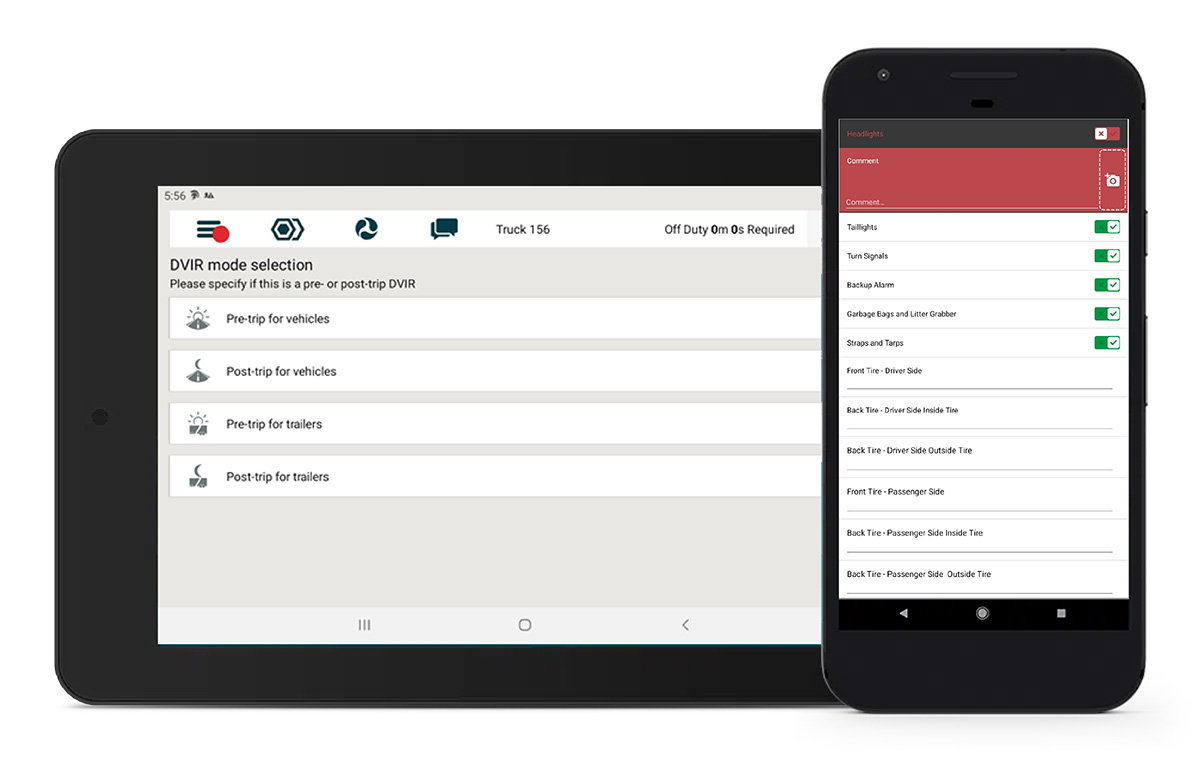
Forward Thinking Systems built eDVIR directly into the Field Warrior mobile app as part of a broader fleet compliance and operations platform. The DVIR module runs alongside Suivi par GPS, Conformité ELDet dispatching in the same app, so drivers aren’t switching between multiple tools, and fleet managers get a single view of vehicle health, driver hours, and location data together.
Drivers complete guided inspections on their phone, attach photos of any defects, and submit with a digital signature. Defects are immediately visible to dispatch and maintenance. The repair certification workflow closes the loop without paper. And every completed inspection is stored, searchable, and exportable for audit response.
Instead of a standalone DVIR app bolted onto your fleet, Field Warrior’s DVIR is integrated into how your fleet already operates. If you’re evaluating options, Field Warrior is worth looking at alongside whatever else is on your shortlist.
No. Electronic DVIR is permitted but not required. Paper DVIRs remain compliant as long as all required elements are present. However, eDVIR offers significant compliance and operational advantages, which is why most larger fleets have made the switch.
Yes. An officer can request to see the last DVIR during an inspection, and an electronic record displayed on a compliant device is accepted. The system should also be able to produce a printable version if needed.
That’s a serious violation — both a driver violation and a carrier violation. DVIRs exist to prevent exactly this situation. The record of the defect and the vehicle’s subsequent movement is all an auditor needs to establish the violation.
Yes. A separate DVIR is required for each vehicle unit; tractor and trailer are inspected and documented separately. Compliant eDVIR platforms support multi-unit inspections within the same inspection session.
FMCSA requires a minimum of 3 months. Many fleets retain records for 12 months or longer for internal purposes. Cloud-based eDVIR platforms typically retain records for the duration of your subscription, so this usually isn’t a concern.
Messages récents
Catégories
Rester en contact


Prêt à rendre la gestion du parc automobile plus facile à gérer ?