The Supreme Court’s Montgomery decision gives brokers more reason to scrutinize carrier safety practices. Here’s how fleets can turn documented safety performance into a competitive advantage.
Índice
What happens when a broker asks you to prove that you’re a safe carrier? You can easily say yes, but the harder part is proving it. Can you pull up the safety events? Show the video clips, the driver’s response, the coaching that followed, and the corresponding hours-of-service record? Because brokers now have more reason to ask those questions.
On May 14, 2026, the U.S. Supreme Court ruled unanimously in Montgomery v. Caribe Transport II, LLC that federal law does not block state negligent-hiring lawsuits against freight brokers. That means a broker may have to defend how it chose a carrier after a crash. The ruling doesn’t make brokers automatically liable when a carrier they hired has a problem, but it means those negligent-hiring claims can proceed in state court.
This puts more pressure on brokers to examine carrier safety practices, and on carriers to demonstrate those practices. And that’s where safety data becomes more than a compliance record.
Most of the coverage has focused on brokers facing higher insurance costs and more litigation exposure. But carriers are affected too, because the added due diligence lands on them.
A broker defending a negligent-hiring claim will need to show what it knew about the carrier and what it did to vet it. Registration and insurance are just the starting point. Safety ratings, Compliance, Safety, Accountability (CSA) scores and inspection history are already part of most vetting processes; after Montgomery, expect brokers to go further and ask about the practices behind those numbers:
That makes the ability to produce those records quickly more important. If a broker asks how you’ve handled a safety issue, you should be able to produce a paper trail showing what happened and how you responded.

Most fleets already collect this information. The difficulty is that a safety event rarely lives in one place. The video may be in the camera system, the driver’s response in a coaching workflow, and the corresponding hours-of-service information in the electronic logging device (ELD). Each system holds its own part of the record.
If someone asks for the complete record six months later, the challenge isn’t necessarily having the information. It’s pulling all of it together into something a broker or an attorney can follow. That takes time, and it depends on people remembering where everything is.
A record that holds up under questioning follows the event from start to finish. It should show:
Each of those pieces exists in most fleets. What varies is whether they’re connected to each other.
FleetCam, DriveShield, and IntelliHub each cover part of that chain, and they’re built to work as one system.
When a safety event happens, FleetCam provides the first piece of the record: what actually happened. Video captures the event, and in-cab alerts notify the driver when the system detects unsafe driving behaviors such as distraction, fatigue, harsh braking, or phone use. Each event is stored with its timestamp, location, and the data that triggered it.
From there, DriveShield documents the response. The driver can review the event, acknowledge or dispute it, and provide an explanation. Plus, the exchange between driver and their coach is saved with the event. When a driver’s events reach a pre-set threshold, training can be assigned, and the completed course becomes part of the record. The scorecard trends, past activity tracking, and emerging patterns then give the fleet ways to see whether the driver’s behavior improves over time.
IntelliHub adds the operational information around the event. ELD records show the driver’s duty status at the time, with each entry marked as automatically recorded or manually entered. Location history and vehicle data fill in where the truck was and what it was doing. When a broker or auditor needs the hours-of-service record, it can be exported and sent directly to the FMCSA.
Put those pieces together and your team has something more useful than a collection of individual system records: a searchable history of what happened and how your organization responded.
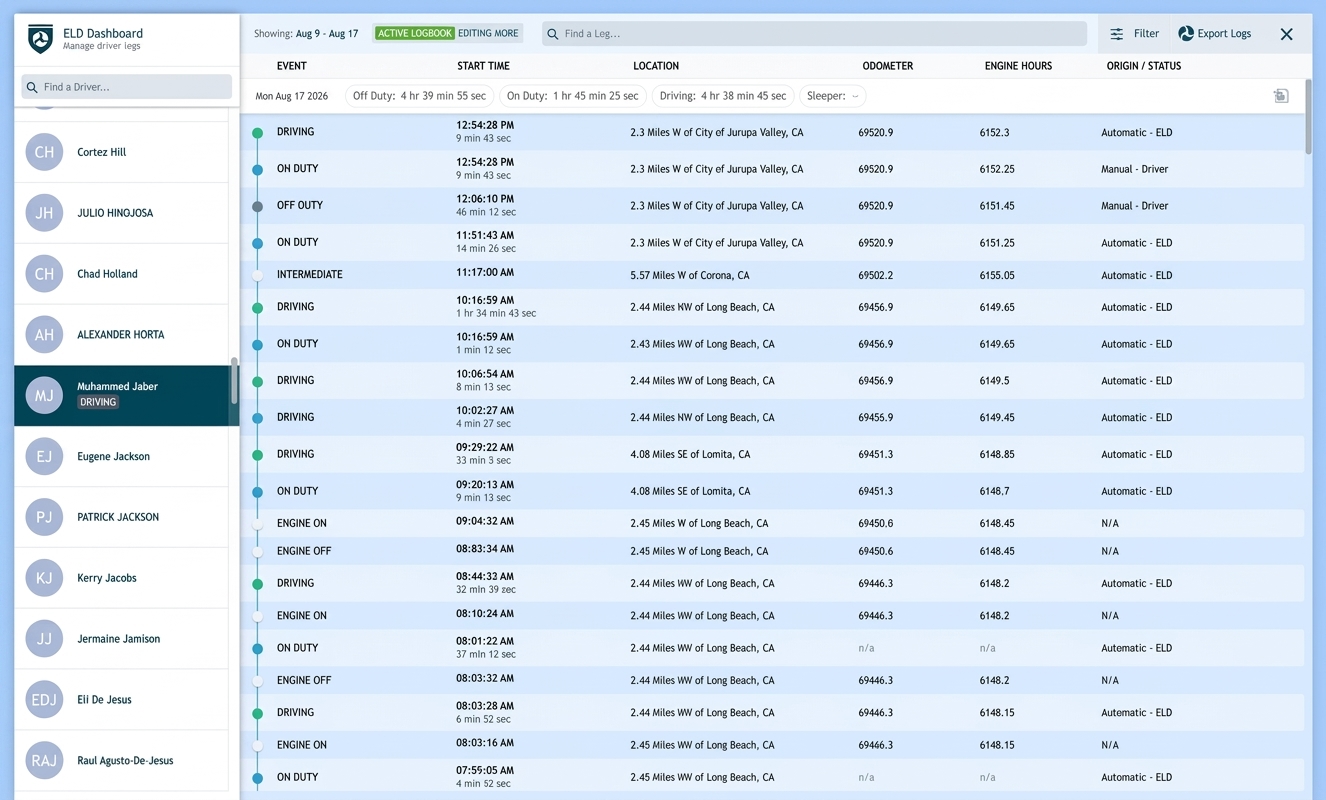
When a broker asks about your safety practices, “we take safety seriously” is the answer everyone gives. A carrier that can pull up a specific event, the driver’s response, the training that followed, and the ELD record for that day is giving a different kind of answer. It shows there’s a process, and that the process is actually being followed.
That’s useful in a compliance review, but it can also matter in a sales conversation. When two carriers offer similar rates and service, being able to demonstrate a documented safety process gives a broker another reason to choose you.
Ready to turn your safety data into proof you can put in front of customers and brokers? See how our end-to-end fleet management platform captures safety events, documents corrective action, and gives your team a searchable record of fleet performance.
The Supreme Court ruled that the Federal Aviation Administration Authorization Act’s safety exception allows state negligent-hiring claims against freight brokers to proceed when they concern motor vehicles used in transportation. The Court reversed the Seventh Circuit and sent the case back for further proceedings.
No. The decision means certain negligent-hiring claims against brokers are not automatically blocked by federal preemption. It does not establish automatic liability whenever a carrier causes a crash or commits a safety violation.
The decision may give brokers more reason to examine a carrier’s safety practices when selecting transportation providers. For carriers, that makes it increasingly useful to maintain accessible records showing how safety events are identified, addressed, and followed up.
A useful safety record can connect the event itself with the driver’s response and the fleet’s follow-up. Depending on the systems a fleet uses, that may include video, vehicle and location data, driver coaching records, training, and the applicable hours-of-service records.
Fleet management systems can bring safety events, video, driver coaching, training, vehicle data, and ELD records together so fleet teams can find and review the history of an event without reconstructing it from separate systems.
Entradas recientes
Categorías
Mantente en contacto


¿Preparado para hacer más manejable la gestión de flotas?