While most small waste collection companies are still fighting disputes, the leader players use PTO-triggered service verification to make missed pickup arguments a thing of the past.
The call comes in around 2pm. A customer says their bin wasn’t picked up this morning. The driver swears he made the stop. The dispatcher doesn’t have a record either way. So the company does what most companies do: Issues a goodwill credit, logs a callback trip, and moves on. Cost of doing business.
The driver’s reputation takes a hit he didn’t deserve. The billing team spends forty minutes on a problem that wasn’t real. And the same customer will call again next month, because there was no consequence and no proof.
This happens dozens of times a month at mid-size haulers. Not because drivers aren’t doing their jobs, but because verifying each service eats up time and resources — turning lost revenue into a heavy-lift logistical problem.
Most fleet managers think about missed pickup disputes as a customer service problem. The actual cost is much broader and messier than that.
Start with the callback trip itself. Fuel, driver time, and vehicle wear on a return visit to a stop that was already serviced. For a residential route, that’s typically $60-$150, depending on proximity and route density. Multiply that by 15-25 disputes per month across a modest-sized fleet, and you’re looking at $1,000-$3,500 in callback costs alone — before anyone’s touched the billing dispute.
Add the back-office time. A dispatcher or customer service rep spends 30-45 minutes investigating a complaint by pulling driver logs, calling the driver, and trying to reconstruct what happened from memory. Not a trivial cost. And at scale? It adds up to hours per week absorbed by a problem that generates zero revenue.

Then there’s the service credit itself. Even when haulers are confident the pickup happened, many issue credits anyway to preserve the relationship. That’s a rational, long-term decision but it compounds quietly over time.
And underneath all of it is the driver. Every unverified dispute puts the burden of proof on the person least equipped to provide it. Drivers who get blamed for things they didn’t do don’t stay. In an industry already struggling with retention, that’s not a small problem.
The technology behind service verification isn’t complicated. The reason it works is that it’s passive; it doesn’t ask anything of the driver.
When a side loader reaches a stop, the lift arm engages. That engagement activates the Power Take-Off (PTO) system that drives the arm. A service verification system reads that PTO signal in real time and creates a timestamped event record tied to the vehicle’s GPS coordinates. You capture the address, truck, driver, date, and time. And if cameras are mounted on the vehicle, a video clip of the stop is automatically captured and attached to the record — the empty bin, the arm position, the street.
When a customer calls to say their pickup was missed, a dispatcher pulls up the stop record. It shows the truck was at that address at 7:14am. The arm engaged for 23 seconds. Here’s the video of the bin being emptied. Dispute resolved in under five minutes, often on the same phone call.
No driver has to remember anything. No one pulls logs or reconstructs a timeline. The record exists because the truck did its job.
For rear and front loaders, the same logic applies. Compactor cycles, lift activity, and GPS stop data combine create the same irrefutable record. The system fits the vehicle, not the other way around.
The value happens where the metal meets the bin. By integrating with the vehicle’s brain, you capture the data that matters:
Here’s what many teams are missing. The data you’re collecting to resolve disputes is also your operational intelligence.
Dwell time per stop becomes visible. If one stop on Route 7 consistently takes three times longer than comparable stops, that’s worth knowing. It could be a blocked access issue, a driver behavior pattern, or a container placement problem that keeps generating complaints.
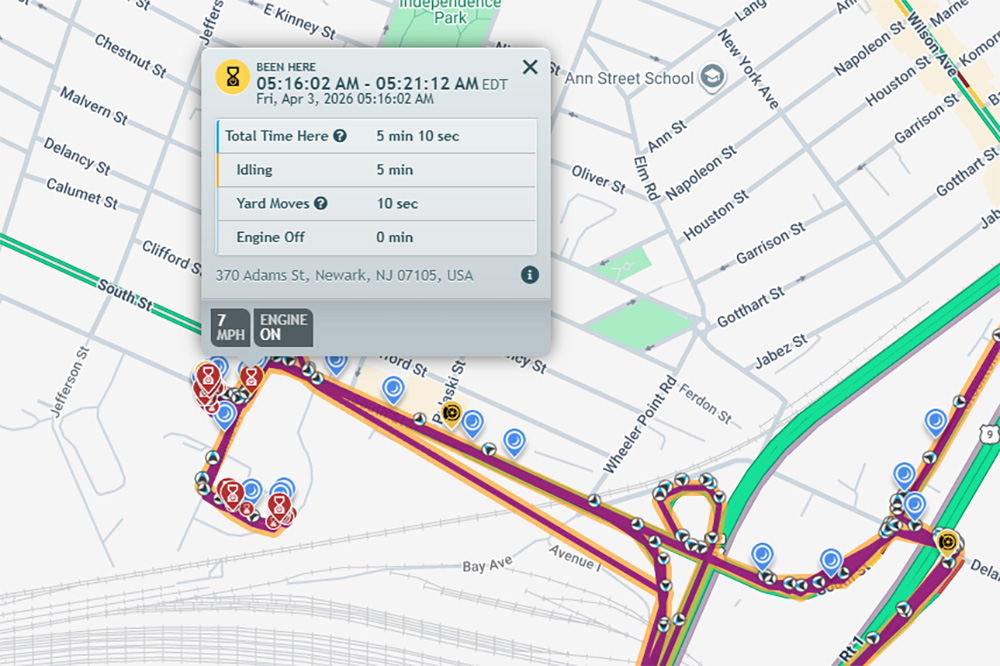
Container exceptions become proactive, not reactive. When the camera shows a blocked driveway or a bin that wasn’t put out, the dispatcher can contact the customer before they ever call in. You’ve completely changed the dynamic. Instead of defending against a complaint, you’re demonstrating accountability.
Vehicle health emerges from the same data stream. PTO engagement patterns over time tell you how hard the hydraulic systems are working. Unusual dwell times can flag mechanical issues before they become mid-route failures.
The data from a single stop — timestamped, GPS-tagged, camera-confirmed — is the foundation of a smarter operation. Most haulers are sitting on it without knowing it.
Efficiency drives growth, and growth drives revenue. Leading waste management companies invest in fleet telematics because they see the return. For small and mid-size haulers, the system pays for itself by reducing missed pickup disputes, improving efficiency, and preventing costly downtime, yet many operators still aren’t aware of the opportunity.
Municipal contracts are changing. Best efforts aren’t enough to win a city or county bid anymore. We are already seeing municipal RFPs that require:
If you can’t provide a digital “handshake” for every lift, you’re not just losing money on disputes, you’re potentially losing your seat at the table for the most stable, long-term contracts in the industry. Investing in verification now isn’t just about today’s callback; it’s about being contract-ready for tomorrow.
Waste drivers navigate 400+ stops a day in tight urban environments, operating heavy machinery around pedestrians, cyclists, and parked cars. They’re skilled, they’re experienced, and they’re routinely blamed for things they didn’t do — because without data, their word doesn’t carry enough weight.
Service verification flips the script. The same system that creates an irrefutable stop record also defends the driver in every dispute. When the footage shows the bin was empty, the driver doesn’t get a note in their file. When the PTO timestamp shows the arm engaged, the credit doesn’t get issued.

Most fleet tech feels like a coach in the passenger seat pointing out mistakes. Service verification is different. It’s the driver’s best witness. That distinction matters more than most fleet managers realize:
If your drivers don’t trust your fleet technology, you may have the wrong fleet technology.
Service verification for waste fleets is no longer an edge-case feature. It’s becoming the baseline expectation for haulers who want to protect their drivers, reduce back-office overhead, and position themselves for the municipal contracts that will define the next decade of the industry.
The data is already being generated on every route, every day. The question is whether your operation is capturing it.
See how PTO service verification works for waste fleets with a 30-minute demo.
Recent Posts
Categories
Stay in Touch


Ready to make fleet management more manageable?